
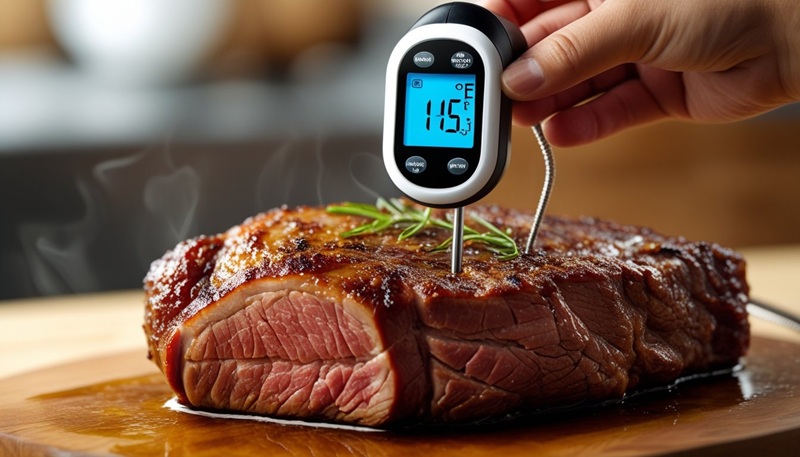
To be honest. I used to think owning a thermometer meant my meat was automatically going to turn out perfect. Then one day I checked a pork shoulder, temp read 203, and that thing still felt tight like a motorcycle tire.
Turns out, I had the probe shoved right against a fat pocket. Rookie move.
So, using a thermometer helps, but where you stick your meat probe matters a whole lot more. Let me walk you through the way I do it now, after years of cooking and making mistakes.
Why Probe Placement Matters
Meat does not cook evenly. The outside hits temperature faster than the inside. That is why you have to measure the center of the meat.
Eddie’s Tip! The thermal center is the coldest part, and it’s the only part that tells you when your food is truly done.
Also:
- bones heat faster than meat
- Fat gives false readings
- Shallow probes only read the surface
General Rules I Follow Every Time
If you follow the tips here, I think you will have the best result.
Aim for the thickest part
Most meats have a clear “thickest section.” Go right into the middle of that. Don’t just poke the easiest spot to reach.
Stay away from bones and big fat pockets
If the probe taps bone, the reading jumps. If it sits in fat, the reading lies. I don’t like liars. Especially when I’m hungry.
Thin meats need a sideways approach
If you are cooking things like burgers or thin chops, slide the probe in from the side straight into the middle. Works way better than trying to stab from the top.
Eddie’s Tip! If your probe touches bone or fat, you will pull the meat way too early and end up with chewy brisket or undercooked chicken.
Been there, done that.
If you’re brand new to thermometers, make sure you read this easy guide on using a meat thermometer before your next cook.
Where I Place the Probe (Meat By Meat)
Whole poultry (turkey, chicken)
Stick the probe into the deepest part of the thigh. I also check the breast because it cooks at a different pace. Stay clear of the bone. It will fool you every time.
Chicken breasts and thighs
Same situation. Go for the thickest part, avoid bone, then check again if you’re unsure.
Roasts and big cuts
Roasts, pork loins, beef roasts. Go halfway inside the thickest part. If you are doing a big cut, insert the probe deep enough that the actual sensor tip is centered in the meat.
Burgers, chops, thin steaks
Slide the probe in from the side. Aim for the thickest center. When you go from the top, you only measure the top part and end up overcooking.
Brisket and smoker cuts
Here is where things get serious. I stick the probe right in the thickest part of the flat. If you’re separating the point and flat, test each.
Don’t panic if temps wander around a bit during the stall. That’s just brisket being brisket.
Probe placement is critical, but how you monitor that probe over time matters too. During long smoking sessions, the type of thermometer connection can make a big difference in how often you check temps and how much freedom you have to step away.
If you are unsure whether Bluetooth or Wi-Fi makes more sense for your setup, I explain the real BBQ differences in my guide comparing Bluetooth vs Wi-Fi meat thermometers.
Eddie’s Tip! Even when I use a digital probe thermometer, I check again with my handheld thermometer!
Little Tricks That Make a Big Difference
Sneak up on the reading
Push the probe in, then slowly pull it out till the temp drops. Then push back slightly until it steadies. That’s usually your coldest part.
Know where your sensor actually is
Some thermometers have a notch or a mark showing where the sensor ends. Make sure that part is inside the meat, or you’re basically testing air temperature.
Double-check tricky cuts
Whole birds and big briskets are rarely even. Don’t be scared to check another spot.
Common Mistakes (I Made Every One of Them)
- Touching bone
- Probing too shallow
- Guessing the center
- Leaving the probe in fat
All those mistakes give you wrong readings. You end up pulling too soon—or too late—and nobody’s happy.
Eddie’s Tip! If your probe reads “done” but your meat still feels stiff, don’t panic. Temperature is part of the story. Texture matters, too. I call it “the poke test.” When brisket slides like warm butter, then it’s done.
Quick-Reference Guide
| Meat | Where I Stick It |
|---|---|
| Whole birds | Deepest part of the thigh, then thickest breast |
| Chicken pieces | Thickest part, avoid the bone |
| Roasts | Middle of the thickest section |
| Steaks & chops | Go in from the side |
| Brisket | Thickest part of the flat (check point if needed) |
| Burgers | Thickest part of the flat (check point if needed) |
Meat Thermometer Probe Placement – My Experience
I used to rush things and just poke wherever. Now I am a whole lot more intentional about landing that probe right in the heart of the meat. After a few cooks, and using one of my picks for the best BBQ thermometers, you will feel it. It becomes second nature, just like checking your smoker temp by instinct or knowing when ribs are ready by tug.
A thermometer doesn’t magically cook perfect meat. But a thermometer in the right place sure makes you feel like you know what you’re doing. And honestly, that’s half the fun.
Related Posts


Eddie van Aken – The Grilling Dutchman
Eddie van Aken is the founder of The Grilling Dutchman, where he teaches practical, no-nonsense BBQ and outdoor cooking. With years of hands-on experience working with grills, smokers, and live fire, he focuses on techniques that actually work in real backyards.
When he’s not cooking, Eddie tests and reviews outdoor gear and equipment for PracticalBackyard.com. Learn more about Eddie van Aken.