
If you have ever looked at your smoker’s lid thermometer and thought, “That can’t be right,” you’re not wrong.
This is one of the most common mistakes I see with new smoker users. And honestly, it messed me up too when I started. Once I fixed where to measure smoker temperature, and I measured temperature, my cooks got easier almost overnight.
Key Takeaway
Measure smoker temperature at grate level, not at the lid. Grate-level readings reflect the true cooking temperature and help explain uneven cooks, hot spots, and misleading lid thermometer readings.
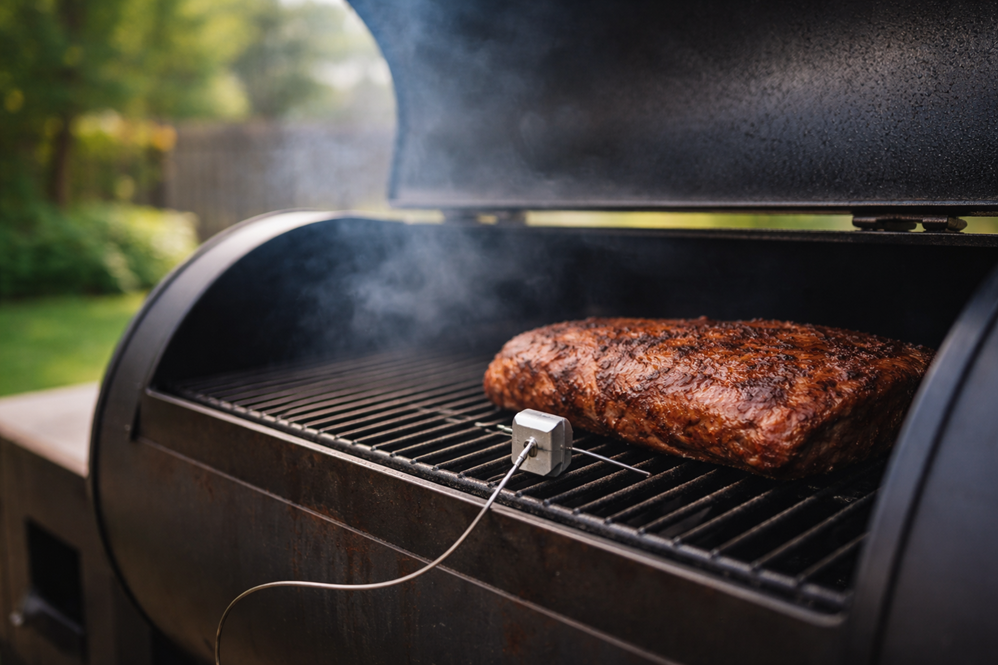
Let’s clear this up. The problem usually isn’t the smoker—it’s where the temperature is being measured. Heat behaves differently inside a smoker than most people expect, and measuring in the wrong spot leads to bad decisions and inconsistent results.
If you’re still getting comfortable with low and slow cooking, my in-depth Smoking Basics guide walks through the fundamentals, so this probe placement stuff makes more sense.
Why Smoker Temperature Is So Easy to Misread
Most smokers come with a thermometer built into the lid. That’s where people look first. It feels logical.
The problem is simple:
Hot air and cooking temperature are not the same thing.
Heat rises. Meat doesn’t.
So the temperature at the top of the smoker often has very little to do with what your food is actually experiencing.
That’s why ribs burn on one side, chicken cooks unevenly, or brisket takes way longer than expected. Even when the gauge says you are “right on target.”
If you’re new to digital thermometers, I break down the basics in my guide on how to use a meat thermometer correctly, including when to probe meat and when to measure air temp.
Why the Lid Thermometer Doesn’t Tell The Story
The lid thermometer measures air temperature, not cooking temperature. This, in combination with the fact that most of them are anything but accurate, is enough reason not to trust your lid thermometer.
A few reasons it’s unreliable on its own:
- It sits several inches above the food
- It’s affected by radiant heat and airflow
- It doesn’t show hot spots or cool zones
- It reacts slowly to changes
I still glance at mine sometimes, but I stopped trusting it years ago.
For me, it is more of a trend indicator since I know it is off by about 50°F compared to grate level temperature.
The One Place That Matters Most: Grate Level
Eddie’s Tip! If you only remember one thing from this article, make it this: Measure temperature at grate level, right where the meat sits.
That is the temperature that actually cooks your food.
I have seen differences of 20–50°F between the lid and the grate. Sometimes more. Once you see that for yourself, the confusion finally makes sense.
Grate-level temperature will tell you, besides the exact temperature, the following:
- Why does meat cook faster or slower than expected
- Why does one rack finish before another
- Why “perfect temps” still give bad results
This is the moment when smoking starts to click, and we don’t guess anymore.
Eddie’s Tip! If your smoker has multiple grates, don’t assume they’re the same temperature. They almost never are.
If you’re shopping for a thermometer and are not sure which tech makes sense, I compared Bluetooth vs Wi-Fi meat thermometers and where each one actually works best around the grill.
Hot Spots and Cool Zones Inside a Smoker
No smoker heats evenly. Not offsets. Not pellets. Not drums. At least I have never found one.
There are always zones that are hotter or colder, and here are some of them:
- Closer to the fire = hotter
- Farther from the heat source = cooler
- Edges cook different than the center
That is normal, and once you know that, you can adjust your cooking to that.
What matters is knowing where your food is sitting relative to those zones. Measuring at grate level helps you learn your smoker instead of fighting it.
Once you understand this, rotating meat, from hot spots to cooler spots, actually makes sense.
Eddie’s Tip! In colder weather I use a welding blanket for my smoker. This keeps the temperature more even during the cook.
How I Place My Temperature Probe (Real-World Setup)
Here’s how I place my probe when I want to make sure I am checking the right smoker temp:
- Clipped to the grate, not hanging in midair
- Close to the meat, but not touching it
- Never touching metal or the smoker wall
- Away from direct flame or heat deflectors
This is a very simple setup, but very reliable and has never failed me.
Eddie’s Tip! I want to know what the meat feels. Not what the smoker might be doing somewhere else.
Why Chasing the Gauge Ruins Good BBQ
This is where a lot of people, including myself in the past, get into trouble.
- They see a number move.
- They panic.
- They start adjusting vents.
Now the fire is messed up, and the smoke turns nasty. I have done it more times than I want to admit.
Good BBQ comes from stable heat, not perfect numbers. Once you measure your grill temperature in the right spot, you stop overreacting and let the smoker settle in.
You also have to realize that the temperature fluctuates, and I suggest reading my BBQ temperature range post to learn more about not chasing the perfect temperature.
This is also why I stopped trusting built-in lid thermometers. I explain that mistake in more detail in why I stopped trusting grill dome analog thermometers.
Eddie’s Tip! That is when the whole cook gets calmer, and you end up with better results.
Common Temperature Measuring Mistakes I See All the Time
These show up again and again:
- Trusting only the lid thermometer
- Measuring too high above the grate
- Placing probes against metal
- Measuring in a hot spot and assuming it’s the whole smoker
- Making constant adjustments instead of waiting
Fixing just one of these usually improves results right away.

Where to Measure Smoker Temperature – My Experience
Once I stopped trusting the lid thermometer and started measuring at grate level, everything got easier.
- My cooks became more predictable.
- My food cooked more evenly.
- And I stopped fighting my smoker.
If you are struggling with temperature control, this is one of the first things I would fix. Not a new gear. Not fancy techniques. Just measuring in the right place.
Get that part right, and the rest starts falling into place.
Eddie van Aken – The Grilling Dutchman
Eddie van Aken is the founder of The Grilling Dutchman, where he teaches practical, no-nonsense BBQ and outdoor cooking. With years of hands-on experience working with grills, smokers, and live fire, he focuses on techniques that actually work in real backyards.
When he’s not cooking, Eddie tests and reviews outdoor gear and equipment for PracticalBackyard.com. Learn more about Eddie van Aken.