
You slice into a brisket or pork butt, and there it is. That pink ring right under the bark. Some folks say it proves the meat was smoked “right.” Others say it is fake or just for looks.
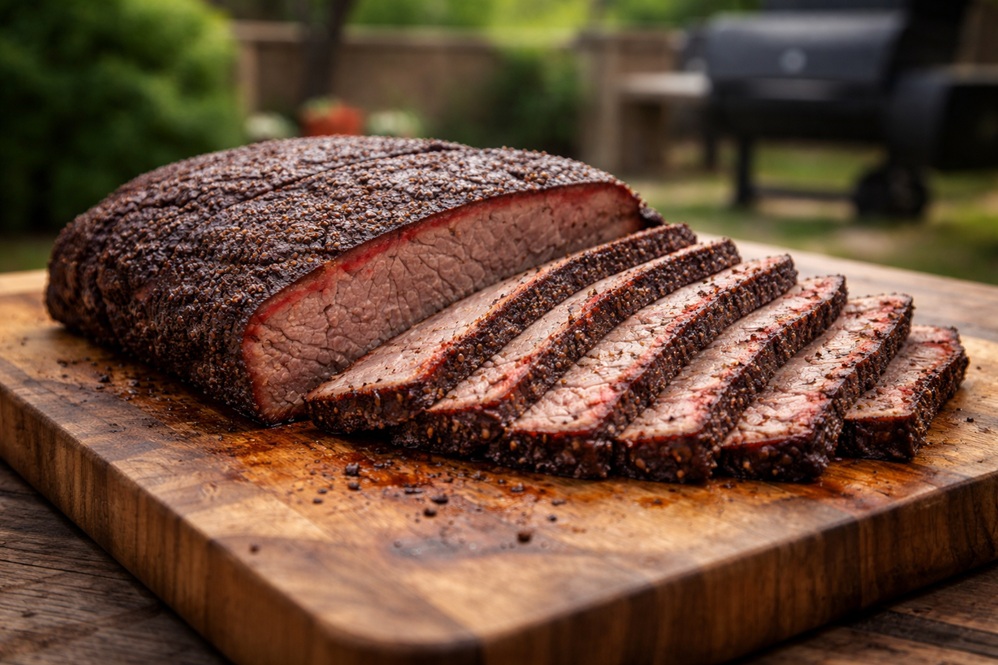
I have heard all of it at the pit and in comment sections. The truth is, a smoke ring is not magic, and it is not a flavor badge either.
It’s a real chemical reaction that happens during low and slow BBQ, and once you understand it, the whole mystery disappears.
What Is a Smoke Ring?
A smoke ring is the pink or reddish layer you see just below the surface of smoked meat. It usually shows up on brisket, ribs, pork butt, and sometimes chicken.
It looks impressive. No doubt about that. But it is important to say this right up front:
Eddie’s Tip! A smoke ring is mostly visual. It doesn’t automatically mean the meat tastes better or was cooked better.
That clean smoke flavor and subtle smoke ring do not happen by accident. It all comes down to airflow, fire control, and patience. The same fundamentals I explain in my how smoking meat really works guide.
What Causes a Smoke Ring in BBQ?
The smoke ring forms because of gases created during the fire. When wood or charcoal burns, it releases gases like nitric oxide and carbon monoxide. Those gases move with the smoke and come into contact with the meat early in the cook.
Inside raw meat is a protein called myoglobin. Myoglobin is what gives meat its red color when it is raw. When nitric oxide binds to that myoglobin before the meat gets too hot, it locks in that pink color.
This all can be achieved by using the right setup for your smoker fire.
Once the meat heats up past a certain point, this smoker ring reaction stops.
That’s why the smoke ring only forms early in the cook. You can’t add it later, no matter how much smoke you throw at the pit.
The Science Behind the Smoke Ring (Without the Lab Talk)
Here’s the simple version.
Raw meat is cool in temperature and full of myoglobin. As smoke flows over it, gases from the fire react with that myoglobin. If the meat stays cool long enough, the reaction continues, and the ring grows deeper.
Once the surface of the meat heats up, myoglobin changes and cannot react anymore. At that point, the smoke ring is done forming. The rest of the cook is about tenderness, bark, and flavor. Not the smoke ring.
Eddie’s Tip! This is also why rushing the start of a cook can reduce the smoke ring
. If the meat heats up too fast, the window for that reaction closes early. That is why it is important to learn how to manage the fire in your offset smoker.
Why You Can Get a Smoke Ring Without Much Smoke
This part surprises a lot of people.
You don’t need thick, heavy smoke to get a smoke ring. In fact, clean, light smoke works better. The gases that cause the ring are present even when the smoke is barely visible.
That’s why pellet grills and even some gas grills can produce a smoke ring. As long as combustion gases are present early and the meat stays cool, the reaction can still happen.
Eddie’s Tip! More smoke does not mean a better smoke ring. Dirty smoke can actually hurt flavor while doing nothing extra for the ring.
Does a Smoke Ring Matter for Flavor?
Short answer: No.
The smoke ring itself has almost no impact on taste.
- It does not make meat smokier.
- It does not make it more tender.
- It does not mean the cook was better.
Flavor comes from smoke particles sticking to the meat, fat rendering, seasoning, and time. Judges in BBQ competitions don’t score smoke rings for flavor.
They look at appearance, tenderness, and taste as separate things.
Eddie’s Tip! A smoke ring looks great, but it is not something I chase.
If it shows up, fine. If it doesn’t, that doesn’t bother me one bit.
Can You Fake a Smoke Ring?
Yes, and this is where things get a little controversial.
Curing salts and certain ingredients like celery powder contain nitrates. Those nitrates can create the same pink color without smoke. That’s how cured meats like ham stay pink.
Some competition teams use this trick because appearance matters. For backyard cooks, it is usually not worth worrying about. You’re not fooling anyone who knows BBQ, and you’re not improving flavor.
Eddie’s Tip! I focus on cooking good meat rather than forcing a ring that doesn’t mean anything.
How to Get a Natural Smoke Ring (If You Care)
If you want a natural smoke ring, here’s what actually helps:
- Start with cold meat straight from the fridge
- Keep the pit temperature steady and not too hot early
- Use a clean-burning fire
- Let the meat absorb smoke early in the cook
- Don’t rush the first couple of hours
That’s it. No tricks. No soaking wood. No piling on smoke. Just good fire management and patience.
My Personal Smoke Ring Trick
I found out that when you keep the temperature in your smoker as low as you can. Let’s say. 160°F, for a longer time, you can have more smoke flavor, and as an extra, you will probably end up with a nicer smoke ring.
Eddie’s Tip! If you are cooking great BBQ but stressing over the smoke ring, you’re focusing on the wrong thing.
Tender meat and good flavor matter way more than a pink line.
Common Smoke Ring Myths (That Won’t Die)
“A big smoke ring means better BBQ.”
Nope. It means a chemical reaction happened early. That’s all.
“More wood makes a deeper ring.”
Wrong. Clean combustion matters more than quantity.
“No smoke ring means bad BBQ.”
Absolutely false. Some of my best cooks had little or no ring.
“You can fix the smoke ring later.”
Once the meat heats up, the window is closed.
Smoke Ring – My Experience
I have cooked plenty of meat with deep smoke rings and plenty without one. The ones people talk about later are always the ones that taste good, not the ones with the prettiest slice.
The smoke ring is real. The science behind it is simple. But it is not a scorecard. Learn what causes it, understand why it happens, and then stop chasing it.
Focus on fire control, seasoning, and cooking the meat right. That’s what actually makes great BBQ.
Eddie van Aken – The Grilling Dutchman
Eddie van Aken is the founder of The Grilling Dutchman, where he teaches practical, no-nonsense BBQ and outdoor cooking. With years of hands-on experience working with grills, smokers, and live fire, he focuses on techniques that actually work in real backyards.
When he’s not cooking, Eddie tests and reviews outdoor gear and equipment for PracticalBackyard.com. Learn more about Eddie van Aken.