
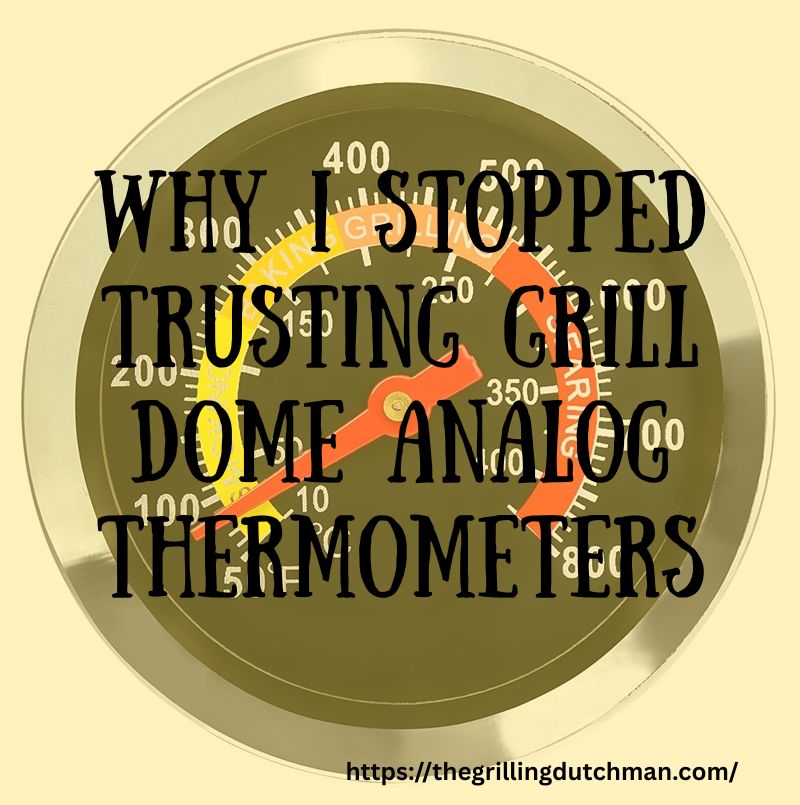
For the longest time, I trusted the thermometer stuck right in the lid of my grill. I mean, it is right there. Looks official. Looks helpful.
Turns out, it is about as accurate as the weather guy trying to predict wind during a tornado. Most dome thermometers are nowhere close to the temperature your meat is actually cooking at.
I learned that the hard way when I started my outdoor cooking adventure. I kept wondering why some cooks dragged on forever while others were done early.
I kept wondering why some cooks dragged on forever while others were done early.
I blamed the charcoal. I blamed the wind. I blamed everything except that little dial staring back at me.
Then I started testing my grills with real digital thermometers, and everything clicked.
The Temp Up Top Isn’t the Temp Down by the Meat
Heat rises, so that fancy thermometer up high in you grill is measuring the hottest air, not the temperature down by your brisket or ribs.
I have seen differences over 50 degrees. Sometimes more.
So while your dome might say 325, your grate might only be sitting around 260.
That is the difference between crispy chicken skin and floppy rubber wings nobody wants to take home. I wish somebody told me that years ago.
Eddie’s Tip! The analog dome thermometer in my charcoal grill reads about 50°F (10°C) higher than the real temperature at grate level.
Most Built-In Thermometers Are Cheap (and they drift)
I don’t mean cheap in a good way. I mean, the “made by the lowest bidder” kind of cheap. A lot of them get worse the longer you own the grill. I’ve seen brand-new grills sitting at 40–80 °F degrees off right out of the box.
Some don’t even agree with themselves a few months later.
I love my BBQ gear, but that’s just a bad tool.
The Real Problem for Low and Slow
Smoking meat is all about controlling heat at grate level. You want steady temperature for hours, not a bouncing number on a dial up top.
Eddie’s Tip! A dome thermometer can’t tell you when the left side of your smoker is hotter, or when your indirect zone is fading, or when your charcoal starts to run low.
It just sits there smiling at you while your cook goes sideways.
What I Do Instead
These days, I don’t even look at the lid thermometer. I go straight to a probe sitting at grate level. Then I stick another probe in the meat.
Related Read: https://thegrillingdutchman.com/where-to-place-a-meat-thermometer-probe/
That gives me the real numbers that matter: where the food cooks, how fast it heats, and when it is actually done. Once I made that switch, my cooks got more predictable.
My brisket finish times stopped being a guessing game. And I don’t open the lid nearly as much. I just glance at the digital display and get back to what I was doing.
Eddie’s Tip! Don’t stick your probe right beside the meat. Keep it close, but give it a little space. Close to the meat throws off the reading and makes you think the grill is running cooler than it really is.
The reason for this is that the cold meat radiates that cooler temperature to the probe of the thermometer and throws it off.
Lid Thermometers Aren’t Totally Useless
To be fair. Dome thermometers do a couple things fine. They tell you your grill is generally warming up, when the charcoal is getting weak, and if something suddenly spikes.
But they are not meant for accuracy. They are more like a speedometer in an old pickup. Good enough to keep you out of trouble, but don’t try to win a race with it.
Why Do Grills Still Come With Them?
Simple reason. They have always been there. People expect to see a thermometer on a grill, and most folks don’t know better yet. Once you start cooking more BBQ, you’ll see the cracks right away.
What I Recommend and Use
Get a probe for grate temperature, use an instant-read for checking doneness, use the dome thermometer like a weather flag. You’ll cook better food and hit your finish times more often.
The use of a recommended BBQ thermometer alone changed my whole BBQ experience.
I have 2 digital probe thermometers that I use all the time. I did in-depth reviews of both of them so you can decide if they are worth your hard-earned money.
Read my review of the Inkbird IBT-26S, and after that, have a look at my review of the ChefsTemp FinalTouch X10, so you can see the differences.
I use both of them and have no real winner.
Eddie’s Tip! If you ever want to see just how wrong your lid thermometer is, run a probe test during your next cook. Place a digital probe right where the food sits and compare the numbers.
Analog Dome Thermometers– My Experience
I stopped trusting dome thermometers years ago. I still glance at them sometimes, but mostly out of habit.
Once I switched to probe thermometers and instant-read thermometers, my BBQ got easier, more predictable, and honestly, just more fun.
I could actually relax instead of hovering over the grill all day. If you are still cooking by the number on the lid, give a digital probe a shot. It’s one of those tiny upgrades that makes a big difference in your results.
One thing I do is test them and recalibrate if needed. You can read my post on how to calibrate a meat thermometer at home to see how easy it is.
There are brands that offer extremely accurate analog thermometers. With the new digital thermometers, it is my opinion that they will become obsolete in the future.
And if you ever hear me say I trust a dome thermometer, well, you know I’ve finally lost it.
Related Posts
Eddie van Aken – The Grilling Dutchman
Eddie van Aken is the founder of The Grilling Dutchman, where he teaches practical, no-nonsense BBQ and outdoor cooking. With years of hands-on experience working with grills, smokers, and live fire, he focuses on techniques that actually work in real backyards.
When he’s not cooking, Eddie tests and reviews outdoor gear and equipment for PracticalBackyard.com. Learn more about Eddie van Aken.