
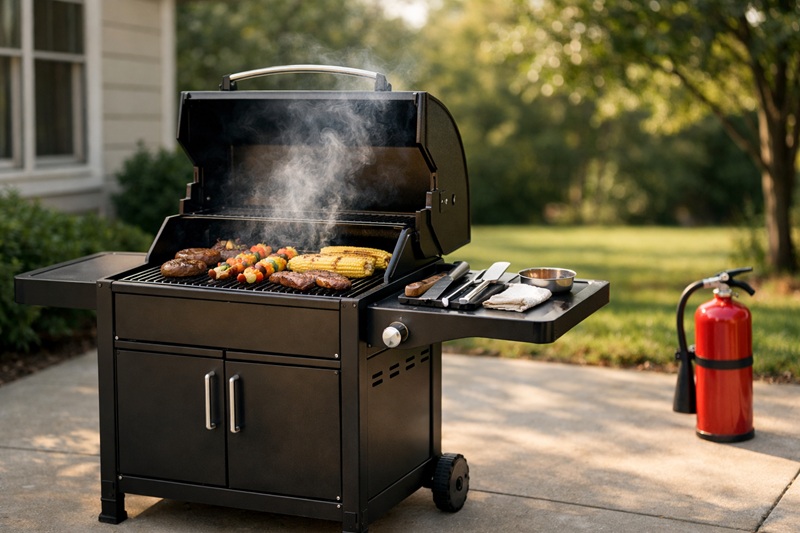
There is something about firing up a grill that just feels right. The smell, the sound, the whole backyard vibe. It is hard to beat.
But I be honest with you. I have seen how fast things can go sideways when you are not paying attention. A quick flare-up, a little grease fire, or a grill sitting too close to the house (1), that’s all it takes.
If you are new to grilling outdoors, I suggest you read my BBQ Basics Guide.
So before you throw those burgers on, here are the safety habits I always stick to. They are simple, but they make a big difference.
Keep Your Grill a Safe Distance
This is one of the easiest things to get right—and one of the most important.
I never place my grill right next to the house, even if it feels convenient. Heat, grease, and open flames don’t mix well with siding, railings, or low-hanging branches.
Eddie’s Tip! I always keep at least 10 feet between my grill and anything that can catch fire.
That includes the house, garage, deck rails, and even outdoor furniture.
Also, make sure your grill sits on a flat, stable surface. I’ve seen grills wobble on uneven ground, and that’s just asking for trouble.
If you’ve got kids or pets running around, create a clear “no-go zone” around the grill. Once that lid opens, it gets hot fast.
Keep Your Grill Clean and Maintained
A dirty grill is more than just ugly. It is a fire hazard.
Grease builds up faster than you think. And when it heats up, it can ignite before you even realize what’s happening.
Eddie’s Tip! I make it a habit to give my grates a quick clean after every cook.
It doesn’t take long, and it keeps things under control. Every so often, I also check the drip tray and burners to make sure nothing is clogged or worn out.
If you’re using a gas grill, take a minute to check your hoses and connections. If something looks cracked or loose, fix it before you light it up.
A clean grill cooks better, and it’s a lot safer.
Never Walk Away From a Hot Grill
This one sounds obvious, but it happens all the time.
You step inside for “just a minute,” and next thing you know, flames are shooting up because of dripping fat or a sudden flare-up.
I’ve had moments where things got hotter than expected, and being right there made all the difference.
Eddie’s Tip! You don’t get much warning when a grill turns on you.
Stay close. Keep an eye on what’s happening. And don’t leave the grill until it’s fully shut down and cooling off.
Have a Fire Extinguisher Nearby
You don’t need it often—but when you do, you really need it.
Grill fires happen more than people think, especially from grease buildup or flare-ups that get out of control.
I always keep a fire extinguisher within reach, but not right next to the grill. You want it close enough to grab quickly, but far enough that you can get to it safely.
Read my Best Fire Extinguisher For The BBQ article.
Make sure it’s rated for grease and electrical fires (Class B and C). And if you’ve never used one before, take a minute to learn how it works. It’s simple, but in the moment, you don’t want to be guessing.
Shut Down Your Grill the Right Way
Finishing the cook is just as important as starting it.
For gas grills, I turn off the burners and then shut off the gas supply. That stops the fuel completely.
For charcoal grills, I close the lid and all the vents to cut off oxygen. That slowly brings the fire down.
One thing I never do is pour water over hot coals. That can create a blast of steam and ash, and it’s not worth the risk.
Eddie’s Tip! Charcoal can stay hot for hours—even when it looks like it’s out.
I always wait until everything is completely cool before dumping ashes, and I use a metal container, not plastic.
I wrote a post on How To Put Out A Charcoal Grill with some tips.
FAQs
What is the safest method of grilling?
Gas grills are often easier to control, which makes them a good option for beginners. You can adjust the heat quickly and reduce flare-ups.
That said, charcoal grills are safe too, as long as you manage them properly. Pellet grills are also a great option since they run steady and controlled.
Eddie’s Tip! At the end of the day, the safest grill is the one you know how to use correctly.
Why is there a risk of fire when grilling?
Most grill fires come from grease buildup or fat dripping onto hot surfaces.
When that grease ignites, it can cause sudden flare-ups that get out of control if you’re not ready for them.
Add in high heat, open flames, and nearby materials that can burn, and you’ve got a situation that needs attention.
Is it safe to grill on grass?
I don’t recommend it.
Grass is uneven, which can make your grill unstable. And if it’s dry, it can catch fire from hot embers or falling ash.
You’re much better off grilling on a flat, non-flammable surface like concrete, stone, or a patio.
Eddie’s Tip! I have a fireproof grill mat under all my grills. -> Click Here To See My Fireproof Grill Mats
Grilling is one of the best ways to cook and spend time outside. It brings people together, and honestly, it just makes food taste better.
But a good cookout starts with doing things the right way.
A little attention, a little preparation, and you can avoid most problems before they even start. And that means you can focus on what really matters—good food, good company, and a grill that works with you, not against you.
Eddie van Aken – The Grilling Dutchman
Eddie van Aken is the founder of The Grilling Dutchman, where he teaches practical, no-nonsense BBQ and outdoor cooking. With years of hands-on experience working with grills, smokers, and live fire, he focuses on techniques that actually work in real backyards.
When he’s not cooking, Eddie tests and reviews outdoor gear and equipment for PracticalBackyard.com. Learn more about Eddie van Aken.