
I have learned the hard way that airflow is the secret sauce of offset smoking. You can light the best fire, use great wood, and have all the right gear, but if air isn’t moving the way it should, your fire will not work.
Your temp will wander, and your smoke will taste bitter instead of sweet.
Airflow is no mystery. It is the missing link between:
• Fire management
• Temperature control
• Smoke quality
Before we get into the how-to, let me tell you about why this even matters.
Why Offset Smoker Airflow Matters
On an offset smoker, you are not cooking with a thermostat. You are cooking with fire and moving air. That air does three big jobs:
- Feeds the fire oxygen, so it actually burns instead of smolders.
- Drags heat and smoke through the cooking chamber.
- Carries old smoke out the chimney, making room for fresh smoke to flavor your meat.
Eddie’s Tip! If you confuse those three, you get thick, white smoke that gums up your bark and makes your meat bitter.
If you understand them, you get thin, blue smoke that tastes clean and delicious.
That is the difference between “meh” and “holy cow, that’s good BBQ.”
How Airflow Actually Moves in an Offset Smoker
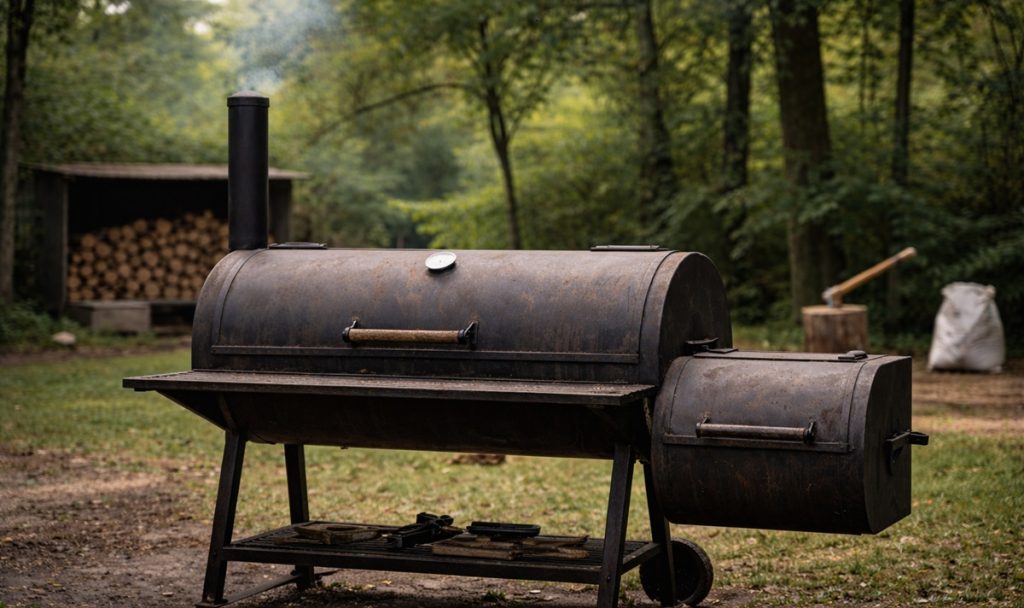
Think of your smoker as a simple wind machine. You have:
- The intake vent (on the firebox) — where fresh air enters.
- The firebox — where wood and/or charcoal burn.
- The cooking chamber — where heat and smoke do their job.
- The chimney — where smoke exits and pulls air through the whole system.
Eddie’s Tip! If you choke off either the intake or the chimney, you choke the fire.
Here’s the real deal: airflow follows a path. It doesn’t swirl randomly. It moves in, across the fire, through the cook chamber, and out the stack. That flow is what keeps the fire alive and the smoke clean.
What Happens When You “Choke” Airflow
Let me tell you from my personal experience:
When the intake gets too tight, the fire tries to breathe through a straw. It dies down, goes smoldering, and starts making thick, white smoke. That smoke sticks to meat and tastes harsh.
Eddie’s Tip! Thick smoke is a sign of a lack of oxygen and incomplete combustion.
When the chimney is almost closed, air just sits in the chamber. Your firebox can be wide open, but without a good exit path, airflow stagnates.
- Heat builds up in weird spots.
- Temps bounce.
- Smoke hangs and turns dirty.
Once, early on, I choked the chimney way down “to hold smoke in.” My firebox took on that thick, billowy white smoke that smells like a campfire gone wrong.
Took me half through the cook to fix that mess. Lesson learned: don’t trap smoke, but let it move.
Why Chimney Position Matters More Than You Think
Here’s the part most folks skip. The chimney isn’t just a smokestack on top of the smoker for looks.
That chimney is your engine.
It’s what creates suction. A gentle breeze that pulls air across the fire and through the cook chamber. The bigger that pull (without being crazy open), the steadier your fire runs and the cleaner your smoke stays.
In real cooking:
- Open the chimney when you’re warming up. Air flows easily, fire builds fast.
- Once you’re up and steady, back off the chimney just enough so you’re not dragging too much heat out, but not so much that airflow stalls.
- Too tight, and the fire starts sulking and spitting nasty smoke.
Eddie’s Tip! This isn’t about eyeballing numbers. It’s about watching how your pit reacts when you nudge that chimney. Tiny moves make big differences.
How Intake and Chimney Work Together
Here’s the part a lot of new folks don’t get:
If one side is wrong, the whole system suffers.
Think of it like a river. Water needs a path in and a path out. Same with air.
- If you open the intake wide but clamp down the chimney, the fire still struggles.
- If you open the chimney wide but choke the intake, you aren’t bringing fresh oxygen in — fire starves.
Eddie’s Tip! The happy place is balanced airflow. Just enough fresh oxygen in and just enough exit path out so air flows naturally, without pushing or pulling too hard.
My rule of thumb:
Feed the fire only what it can burn cleanly. Don’t blast it, don’t choke it. Just let it breathe.
What You Will See When Airflow Is Right
There’s one simple sign that tells you you’re on the right track: thin, blue smoke. Not heavy white clouds. Not greasy gray plumes. Thin, almost invisible blue smoke means your fire is clean, oxygen is balanced, and your smoker is cooking as it should.
Here’s how I read it:
• Thin blue smoke — everything is happy.
• Heavy white smoke — time to fix the fire or improve airflow.
• Smoke that hangs low and stinks — you gotta open up the intake or chimney and feed the fire cleaner wood.
Eddie’s Tip! Make airflow your goal first. Once that is steady, everything else, such as temps, smoke flavor, and fire control, gets so much easier.
Offset Smoker Airflow Basics – My Experience
Let me say it straight: There is no right ot wrong with using your air intake or choking you chimeney. All that matters is a clean fire and clean smoke in combination with temperature control.
Are you new to offset smokers? Then I suggest starting with my how an offset smoker works page.
Airflow is not about charts or perfect percentages. It’s about movement. How air travels from where it enters, across your fire, through the cook chamber, and out the stack. How that movement lets your fire burn clean and steady instead of grimy and unpredictable.
Once you wrap your head around that, your confidence jumps. You stop chasing numbers and start reading your smoker like a machine that breathes instead of burns.
That’s when your offset starts to feel familiar. Calm. Predictable.
And that’s when great BBQ starts to happen.
Eddie van Aken – The Grilling Dutchman
Eddie van Aken is the founder of The Grilling Dutchman, where he teaches practical, no-nonsense BBQ and outdoor cooking. With years of hands-on experience working with grills, smokers, and live fire, he focuses on techniques that actually work in real backyards.
When he’s not cooking, Eddie tests and reviews outdoor gear and equipment for PracticalBackyard.com. Learn more about Eddie van Aken.