
When I started on my offset, I thought smoke was smoke. But soon I found out that the wood you burn decides if your brisket tastes as if it comes from a top BBQ shack, or like an old campfire got mad at you.
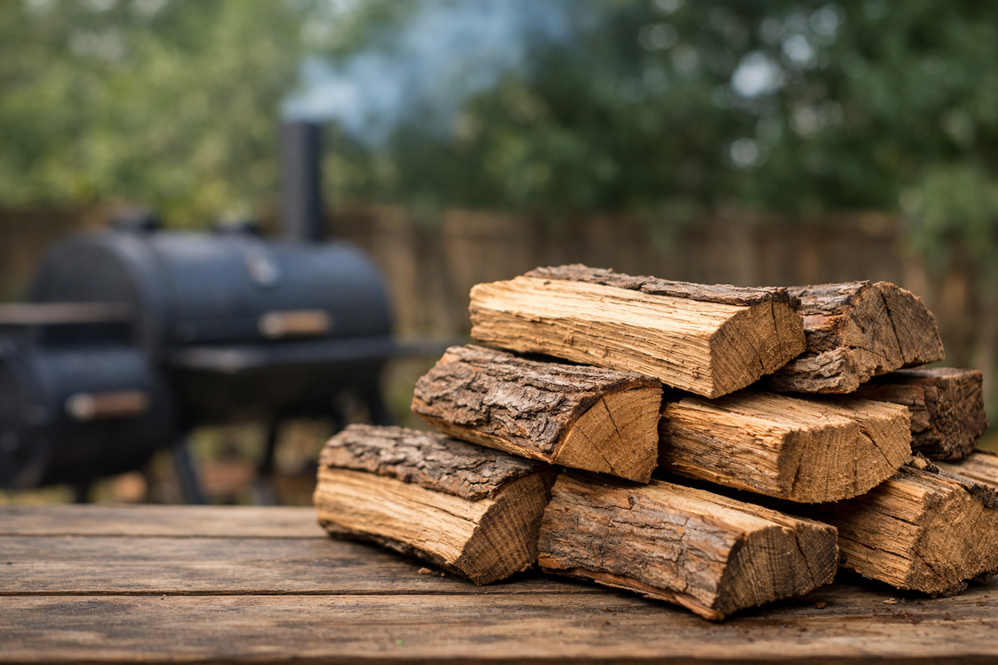
This guide is all about picking the right hardwood, cutting it to the right size, and getting that clean, sweet “thin blue smoke” flavor, and is part of my offset smoker guide.
Why Wood Choice Matters On An Offset
An offset smoker is basically a wood-powered flavor machine.
If your wood is too wet, too big, or the wrong type, your fire struggles. That makes thick white smoke. That smoke can taste bitter, harsh, and kind of ashy.
If your wood is dry, sized right, and burning clean, you get light smoke. That’s the good stuff. It makes meat taste deeper, not dirty.
Use Hardwood, Not Softwood
I stick with hardwoods for smoking. Oak, hickory, pecan, maple, apple, cherry, that whole family.
Eddie’s Tip! I avoid softwoods like pine and cedar. They are resinous, and that resin can wreck the flavor and make nasty smoke.
Best woods for offset smokers (and what they taste like)
These are the woods I reach for most. A lot of BBQ folks agree on these staples because they burn steady and taste right.
Oak
Oak is the “don’t overthink it” wood. It burns steadily, makes good coals, and the smoke flavor is solid without being too loud.
Oak wood on an offset smoker goes best with:
- Brisket and beef
- Pork shoulder
- Ribs
Hickory
Hickory is classic. Stronger than oak. It can taste amazing, but it can also go bitter if you overdo it or burn it dirty.
Hickory wood on an offset smoker goes best with:
- Pork ribs
- Pork shoulder
- Beef (use lighter than you think)
Pecan
Pecan is like hickory’s smoother cousin. Still rich, but sweeter and more “friendly.”
Pecan wood on an offset smoker goes best with:
- Ribs
- Brisket (especially mixed with oak)
- Chicken
Maple
Maple wood is mild and a little sweet. It’s great when you don’t want the smoke flavor to bully the meat.
Maple wood on an offset smoker goes best with:
- Chicken
- Pork
- Game birds
Apple
Apple is mild, sweet, and forgiving. It’s one of my favorite “crowd-pleaser” woods.
Apple wood on an offset smoker goes best with:
- Pork
- Chicken
- Ham
Cherry
Cherry is mild and fruity, and it plays well with stronger woods.
Cherry wood on an offset smoker goes best with:
- Chicken and turkey
- Ham
- Pork ribs
Mesquite
Mesquite is strong. Like, campfire strong.
I use it in small amounts, or for hot-and-fast cooks. On a long brisket cook, it can get too heavy fast.
Mesquite wood on an offset smoker goes best with:
- Beef (short cooks)
- Blends (small amount mixed with oak)
Best Beginners Wood For Offset Smoker
If you are new, don’t try to be fancy. I did that, and it did not end well. Fancy is how you end up eating bitter brisket at 9 p.m. while you pretend it’s “rustic.”
My simple starter plan:
- Start with oak as your main wood
- Add one fruit wood when you want it sweeter (apple or cherry)
- Save mesquite for later
Easy beginner blends I like:
- Oak + apple (great for pork and chicken)
- Oak + cherry (great for ribs)
- Oak + pecan (great “all-purpose” mix)
Split size matters more than most people think
Split size is fire control. Fire control is flavor.
Big splits burn longer, but they can smolder if your coal bed isn’t ready.
Small splits catch faster, but you feed the fire more often.
Here’s what I aim for most days:
- Length: about 8–10 inches (whatever fits your firebox comfortably)
- Thickness: “wrist to forearm” range is a good starting point
Eddie’s Tip! If my smoker is struggling to recover temp after adding a split, that split is usually too big, or my coal bed is too weak.
Clean Smoke vs Sirty Smoke (and what it tastes like)
This is where people get confused.
Clean Smoke
You can see, after a few cooks, by the color of the smoke coming out of your chimney, if you have clean smoke. Clean smoke is:
- Thin blue smoke
- Sometimes almost invisible
What meat smoked with clean smoke taste like:
- Smooth
- Light sweetness
- “BBQ smoke” flavor, not “burnt” flavor
Dirty Smoke
You can see, after a few cooks, by the color of the smoke exiting your chimney, if you have dirty smoke. Dirty smoke is:
- Thick white smoke
- Gray smoke that hangs around
- Smoke that smells sharp or bitter
What meat smoked with dirty smoke tastes like:
- Bitter
- Ashy
- Mouth-drying
- Sometimes, like licking a fireplace brick (not recommended)
Dirty smoke usually happens for a few reasons, and here are the most common ones.
- The wood is wet or green
- The fire doesn’t have enough oxygen
- You throw on a huge split, and it smolders
- The coal bed is not hot enough to ignite clean
If you like to see how I use my wood, I suggest you read my article on how to master clean smoke.
Seasoned Wood vs Green Wood
Seasoned wood is dry enough to burn clean. Green wood is fresh-cut and still full of moisture.
I don’t want green wood in my offset. It is one of the fastest ways to get dirty smoke and bad flavor.
Things to look for if your wood is ready:
- Feels lighter than you expect
- Ends have cracks
- Sounds “sharp” when you knock two pieces together
Things to look for if your wood is too wet:
- Feels heavy
- Steams
- Smells sour or musty
- Makes heavy white smoke
Eddie’s Tip! If you are not sure your wood is dry enough, start with a smaller split and let it fully catch before adding another. If it keeps steaming and smoking thick, stop feeding it and fix the fire first.
How Wood Choice Connects to Brisket, Ribs, and Chicken
It is my experience that each meat “likes” different smoke levels. Here are a few tips that are based on my tasting.
Brisket
Brisket is a large cut of meat and can handle stronger smoke.
- Best starters: oak, pecan, light hickory
if you are using a pellet grill, you can check my best pellets for smoking brisket article.
Ribs
Ribs love balanced smoke. Too much strong wood can get bitter.
- Best starters: oak + cherry, oak + apple, pecan
I dig deeper into that subject in my best wood for smoking ribs article.
Chicken
Chicken takes smoke fast. That’s why lighter woods win.
- Best starters: apple, cherry, maple
Beginner Checklist For Choosing Wood for an Offset Smoker
I can make this into a long part of this article, but here is the short version.
- Use hardwoods
- Start with oak
- Keep splits medium-small
- Make a strong coal bed first
- Don’t feed the fire until the last split is burning clean
Choosing Wood for an Offset Smoker – My Experience
When I started with my Oklahoma Joe offset smoker, I was convinced that with my experience with my ugly drum smoker, I would master this in no time.
Well, I was wrong! This is a whole new thing for me, and I had to start learning to smoke meat on an offset smoker from scratch.
After trying and failing, I decided to start to “play: with my smoker. I made several seizes splits, and was testing the settings of my firebox intake and chimney.
After this, I figured that for my smoker, the best size for my wood was about 8-10 inches long and the maximum thickness of a soda can.
I also found out that my wood worked the best when it was as dry as possible.
Eddie’s Tip! I still use a piece of “green” wood sometimes at the start of my cook to get some extra smoke flavor
However, I only do this with large cuts of meat such as brisket and pork butt.
Eddie van Aken – The Grilling Dutchman
Eddie van Aken is the founder of The Grilling Dutchman, where he teaches practical, no-nonsense BBQ and outdoor cooking. With years of hands-on experience working with grills, smokers, and live fire, he focuses on techniques that actually work in real backyards.
When he’s not cooking, Eddie tests and reviews outdoor gear and equipment for PracticalBackyard.com. Learn more about Eddie van Aken.